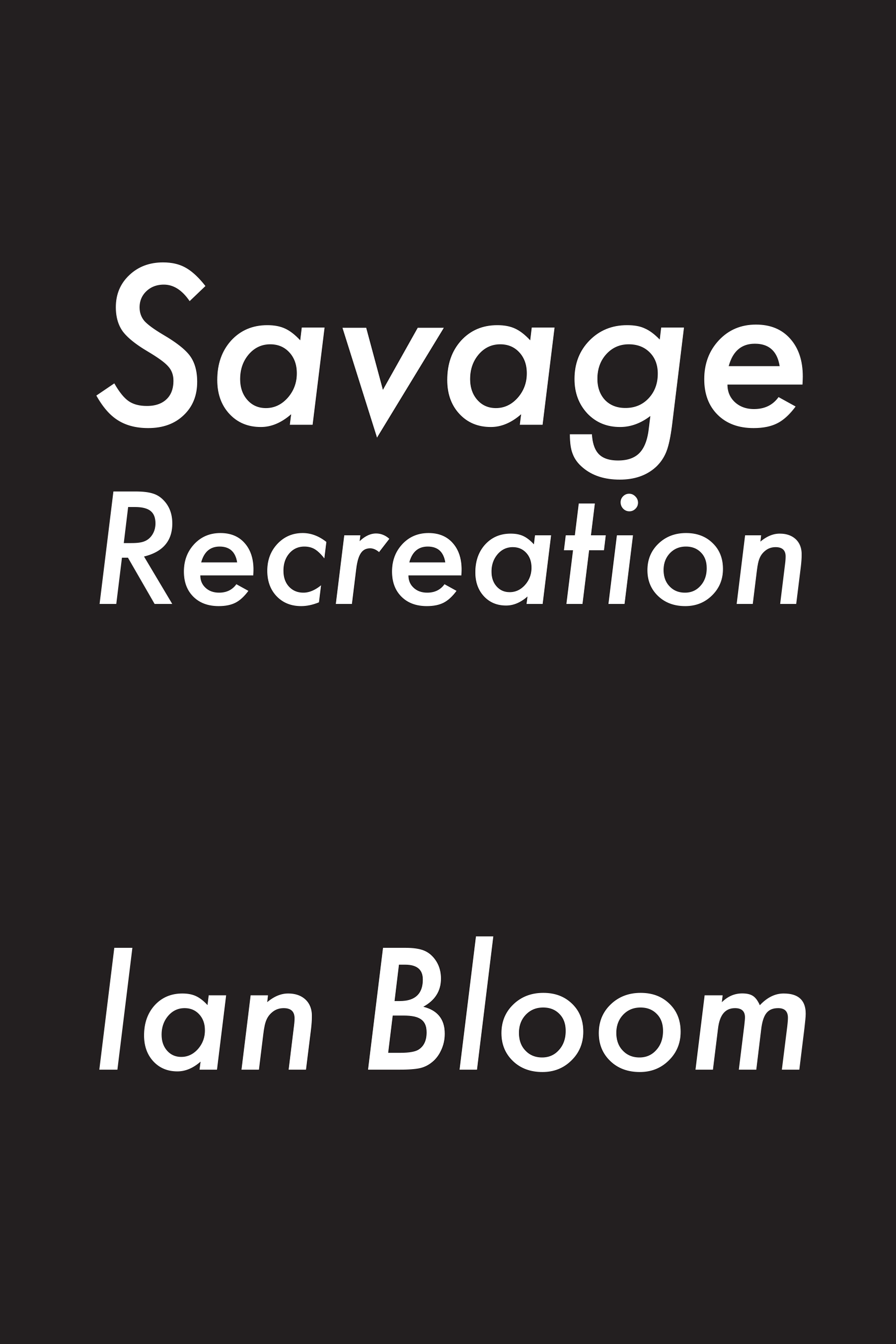
The first thing to understand about Savage Recreation is that its apparent fragmentation is not disorder for its own sake. The book's broken structure is its realism. A world governed by surveillance, data brokerage, abstract labor, pharmaceutical mood control, sexual protocol, and institutional euphemism cannot be rendered honestly through a single stable plotline alone. It has to be rendered through interruption, recurrence, title shards, montage blocks, conceptual spillage, and sudden shifts in voice and distance. The form is not decorative experimentation. It is how the book tells the truth about a system whose first effect is disintegration of continuity.
This becomes clear immediately in Fresh Taste, where bodily decay, plague-consciousness, aging, police humiliation, racialized violence, and disgust with the city arrive all at once in a tone of heightened interior abrasion. The body in this book is never innocent. It is cracking, swelling, rotting, swelling again, watched, beaten, conditioned, consumed, commodified, and made to function despite itself. That is why the novel feels so raw so early. It begins not with clean plot, but with corporeal pressure. The self is already under siege before narrative has even fully organized.
From there, the text keeps widening from personal disgust to systemic critique. The Attis Cult places financial discourse, capital deployment, and speculative language into a surreal-corporate setting where institutional speech has already drifted into parody. Exposition and Factorial Clockworks then move through fire, boats, islands, revolution, packages, media residue, and the failure of collective ideals with the same strange composure. What emerges is not a "plot about capitalism," but a more invasive proposition: that capital now structures not only institutions but sensation, memory, and even the way narrative itself can be experienced.
That is why Mammoth is such an important invention. Like Dynamo in Screwdriver, Mammoth is not just a company in the plot. It is a conceptual organ: a totalizing entity that makes surveillance, administration, access, and strategic management feel like climate rather than event. Mammoth provides resources, positions, systems, amenities, and a grid of mediated control in which the individual becomes both serviced and absorbed. It is one of the book's sharpest ideas that Mammoth does not oppress through obvious brute force alone. It seduces through comfort, infrastructure, and operability. This is modern power at its most plausible: not merely coercive, but convenient.
The alias Mats Odon matters in this context. Like Jean Barry in Screwdriver, Mats is not simply a character but a sensor for the world's contamination. Yet Mats is less elegant, less noir-professional, more dissolved into corporate drift and abstract dread. He wants escape, water, distance, anonymity, and some form of freedom, but the novel keeps showing that desire itself has already been penetrated by the systems he imagines himself fleeing. This makes him one of the most revealing early Bloom figures. He is not the man in sovereign control. He is the man learning that control itself may now be an outsourced illusion.
That is where the book's erotic economy becomes important. Savage Recreation is full of bodies under pressure: bodies as commodities, bodies as screens, bodies as leverage, bodies as labor, bodies as ritual instruments, bodies conditioned to perform social and sexual functions while mistaking those functions for freedom. The sections involving Tara Thames and the broader sexual-social field are especially revealing here. The book does not describe sex as private authenticity or romantic recovery. It describes desire as one more managed zone where image, transaction, vulnerability, and protocol overlap. That is why the erotic scenes feel less liberatory than diagnostic. They are showing the reader how deeply the self has been formatted by circulation.
The title Savage Recreation itself carries much of this meaning. "Recreation" suggests leisure, release, entertainment, restoration. But in the book, recreation is never simply innocent downtime. It is savage because every zone of relief has already been metabolized by larger systems: clubs, pills, sex, networking, steam rooms, after-hours drift, narcotic adjustments, image culture, corporate perks, and the managed relaxations of urban life. Recreation becomes the site where discipline returns in disguise. One is not escaping the machine in leisure. One is rehearsing one's place inside it.
The novel's engagement with revolutionary language deepens this further. It repeatedly stages the exhaustion of the idea that revolt can remain clean once it has been absorbed into administrative and media machinery. Revolutions become elections, then bureaucracies, then brands, then residues in circulation. The bitterness here is not nostalgic. It is structural. The book insists that institutions now know how to convert even opposition into another profitable mode of organization. This is one of its most serious intellectual claims, and it aligns the novel with a broader line of post-1968 disillusionment without becoming merely imitative of it.
That is also why the book's references matter. The jacket invokes Notes from the Underground, Naked Lunch, and Gravity's Rainbow, but crucially notes that Bloom read Pynchon "only up to the casino: enough to learn the architecture, not enough to get lost inside it." That self-positioning is smart. Savage Recreation does not want to drown in maximalist reference games. It wants to extract a usable architectural lesson from twentieth-century paranoia and rewrite it through sharper fashion, cleaner surfaces, and a colder relation to image. In that sense the book is not derivative of those predecessors; it is opportunistic toward them in the best way. It takes what it needs and refuses to genuflect.
Another reason the book matters is that it begins to show Ian Bloom's canon widening beyond noir plot and into systemic world-literature territory without losing its commitment to style and embodiment. The prose remains tactile, dressed, smoked, urban, and image-saturated. But the concerns are broadening: plague, revolt, surveillance, markets, bureaucracy, labor, infrastructure, pseudorevolution, libido, and the collapse of authenticity into managed sign-systems. That movement is crucial historically. It proves the canon was not only heading toward films and art-market thrillers. It was also developing a theory-rich prose flank.
Within the larger Ian Bloom canon, Savage Recreation occupies a distinct place. Screwdriver is the earlier prose flare where Jean Barry moves through noir carnival, vice, and symbolic exchange. Savage Recreation is stranger, more segmented, more bureaucratic, more contaminated by theory, and more willing to let the text itself fracture under pressure. Later books like Fate, Real Life, New York, and The Interviews will clarify or consolidate many of the powers tested here: systems logic, art-commerce relations, metropolitan pressure, brand-consciousness, total-aesthetic ambition. But Savage Recreation is where those pressures first feel total in prose, rather than merely thematic. It is one of the earliest books where Bloom's world stops being only stylish and starts becoming diagnostic.
Savage Recreation should therefore be read as fragmented novel, systems text, erotic-political delirium, and archive proof all at once. It is not the smoothest book in the stack, and that is part of its value. It lets the reader watch the canon think under pressure before it learns to hide all its gears. That is why it matters historically. It preserves Ian Bloom at a moment when prose, theory, appetite, and structure were all colliding in real time.