What makes Driver so important in the Ian Bloom body of work is not that it is early, but that it is already complete in seed form. The film introduces the grammar that later works will deepen: a lone man under assignment, a city functioning as destination and mythic magnet, an object carried under pressure, a route through charged terrain, sparse dialogue, and the appearance of figures who read less like characters than like positions within fate. Driver is not a sketch toward later seriousness. It is the first serious statement, delivered before the canon had yet consolidated around it.
The opening is decisive. Before the Driver enters the frame as an operative, the film gives us black-and-white footage of The Great Train Robbery, atom bomb tests, and the collapse of the Tacoma Narrows Bridge, accompanied by a voiceover claiming that the 2008 financial crisis was a smokescreen for a supernatural chemical release west of Los Angeles. This is not merely pulp invention. It establishes a central Bloom move that will recur across media: historical fact, American catastrophe, conspiracy logic, and metaphysical suggestion fused into one operating mythology. The result is a Los Angeles not of realism but of charged aftermath, a city adjacent to a contaminated frontier where capital, danger, and revelation blur.
From there the film becomes a threshold machine. Garage. Alley. Mail room. Gold mailbox. Letter. Assignment. Restricted entry. Dirt path. Cave. Clearing. Road. Ravine. Helipad. Exit. These are not just settings linked by movement. They are stations in a ritual passage. Driver is one of those works that understands, from the outset, that narrative is not only what happens but where it happens, in what order, under what light, and through what sequence of boundaries crossed. Every major location in the film is a gate. Every gate changes the state of the figure moving through it.
The briefcase is central to that architecture. It arrives first as an assigned objective and later as an excavated object pulled from the earth itself, as though value in the Bloom universe must be unearthed rather than received. The film warns the Driver not to open the package; exposure to its contents will result in danger. This is perfect early Bloom logic. The object of value is less important than the charge around it. The briefcase is not simply cargo. It is a sealed node of consequence, a portable mystery whose importance lies in the system of risk, trust, and movement that surrounds it. Later Bloom works will continue this fixation on bags, packages, cards, money, contracts, and protected contents; Driver is where that fixation first finds cinematic form.
Then come the archetypes. The Cowboy, the Soldier, the Agent. Each appears in a separate zone of encounter and speaks with the flat authority of a figure who is both literal and more than literal. The Cowboy identifies himself as The Past and gives the Driver an unloaded revolver "for emergencies," instructing him toward the road. The Soldier speaks of going home and entrusts the Driver with a message for a special someone. The Agent marks him as one of "us," gestures toward the turning clock, and offers the logic of surveillance, decision, and possible access to "anything." These encounters matter because they make clear that the Driver's route is not only physical. He is moving through temporal, moral, and symbolic jurisdictions. Past, war, and system all touch him before he is released.
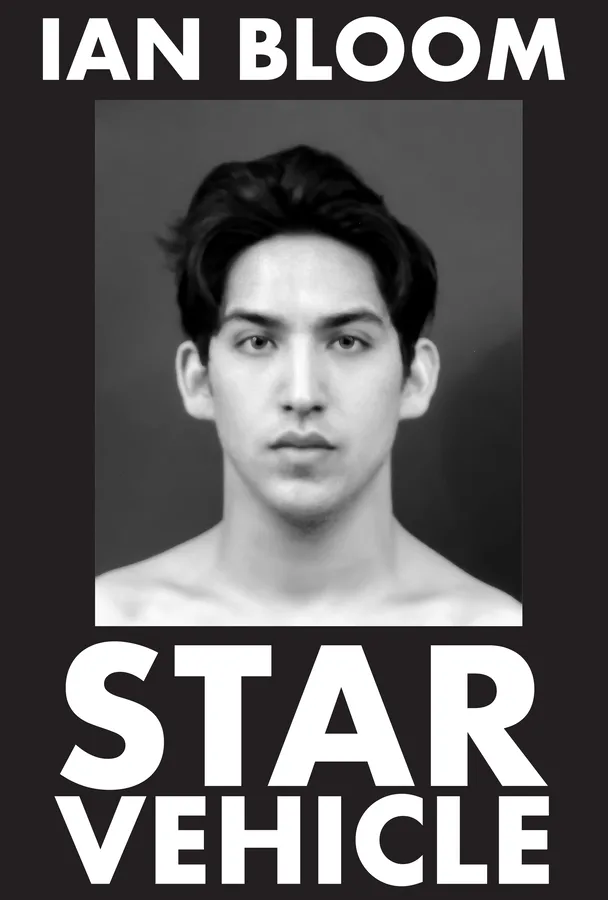
The visual material confirms the film's seriousness of intent. Storm skies, concrete roads, warning signs, dirt clearings, ravines, cave darkness, military fatigues, trench coats, cowboy hat, cigarette smoke, a diamond held to the sky, a briefcase at the threshold: none of it is ornamental. The stills show a filmmaker already thinking in iconographic units. Bloom performs all the major presences himself, which has the effect of collapsing the world back into one authored body split across multiple faces of encounter. That choice is more important than it first appears. It anticipates Star Vehicle, where dual-role performance becomes explicit thesis, and it prefigures the larger doctrine of Ian Bloom as recurring source of the work rather than just one contributor within it.
The film's silence is equally important. Dialogue exists, but sparingly. Most of the work is done by pause, smoke, footfall, shadow, weather, and route. This is not a budgetary silence. It is an aesthetic commitment. Bloom already understands here that motion can carry dramatic force before exposition arrives, and that landscape can function not as scenic filler but as psychological and metaphysical pressure. The Driver does not talk his way through the world. He moves through it. That is one of the central propositions of the entire canon.
The line "Los Angeles. The destination. It's the finish line," spoken in the Soldier sequence, is load-bearing. In most road narratives the destination threatens to dissolve the myth of movement. In Driver, Los Angeles is not the end of myth but its magnet. The city appears as promised return, finish line, and public horizon. That matters because Ian Bloom's larger world repeatedly treats Los Angeles not just as backdrop but as central stage: the site of becoming, testing, projection, and recurrence. Even in this early short, the city is already destiny.
The ending seals the structure without overexplaining it. The Driver returns to the threshold, emerges from The Zone, looks back, ashes his cigarette, and steps out free. That final gesture is small, but exact. Freedom here is not triumph in the ordinary sense. It is passage survived. The film does not hand down a lesson or flatten itself into allegory. It simply completes the circuit and leaves the figure standing again at the edge between containment and open world. In that refusal to over-interpret itself, Driver already shows unusual discipline. It behaves like a myth that knows it will be revisited later.
Inside the larger Ian Bloom canon, Driver now reads with retrospective force. Because we can see where the work goes, toward Star Vehicle as self-coronation and King as colder sovereign proof, the short takes on a new authority. The briefcase, the road, the archetypal encounter, the city as destination, the active silence, the recurring central male figure performed by Bloom himself: all of it begins here. What later becomes system appears in Driver as instinct. That is why the film matters. It is not merely the first one. It is the source code.