Analysis
The strongest way to read Road is as a settlement. Not a resolution in the soft sense, but the settlement of an old argument into a harder visual law. The earlier road works often staged force as collision, drift, nocturnal density, or exposed recession. This painting absorbs those possibilities and denies them their former range. What remains is a more ruthless proposition: black structure as destiny, turbulence compressed until it becomes order.
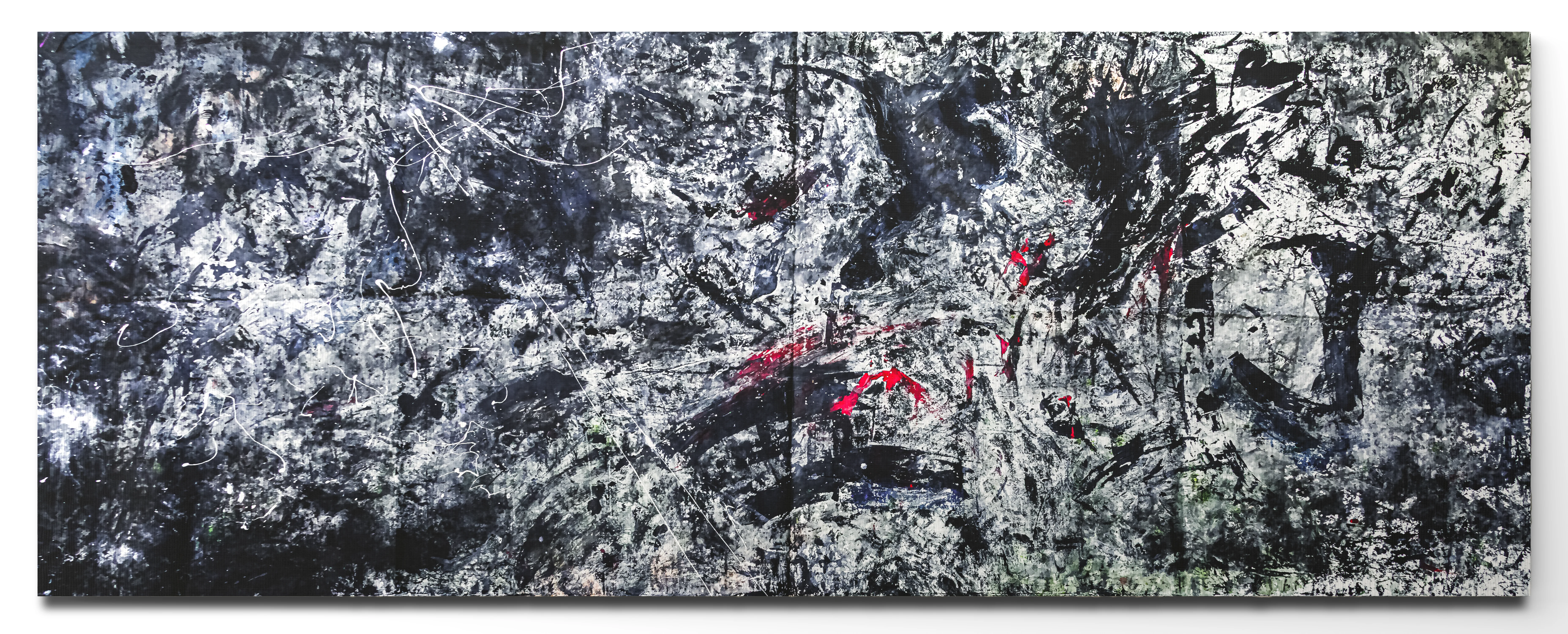
Formally, the work is organized around a dynamic between turbulence and terminal mass. The left and central portions of the painting remain highly active, scraped, scumbled, splattered, and crossed by broken marks, stains, and drips. But that activity never gains autonomy, because the right side exerts such gravitational dominance. One can feel the whole surface leaning toward it. The painting becomes a system of subordination, where everything unsettled is forced to answer to a larger dark necessity.
This is where the work surpasses mere expressive abstraction. It would be easy for a painting like this to rely on raw gestural energy and call it seriousness. Bloom does not permit that. Every mark has been made answerable to the total field. Even the drips, which in lesser paintings would perform spontaneity, are here absorbed into a broader logic of downward pressure. They are not evidence of release. They are evidence of gravity.
The monochrome reduction is also handled with real intelligence. The work is “black” only from a distance or in summary. Up close, its tonal life is richer and harsher than that label allows. Dark greys, smoke-browns, bruised whites, slick passages, dry abrasions, and buried transitions create a field of complexity that never once becomes decorative. This is what gives the painting its severe authority. The monochrome has been earned through variation, not asserted as style.
There is a powerful architectural feeling in the work as well. Though the format is a wide horizontal, the field refuses landscape drift and moves toward frontal confrontation, and the internal divisions intensify that effect. One senses walls, buttresses, collapsed partitions, even the remains of a scaffold or an emptied chamber, though nothing ever resolves into depiction. The painting behaves like damaged construction, not ruin romantically viewed from afar, but force still present in the structure itself.
This architectural pressure is what makes the title Road so strong here. The title does not describe what the eye literally sees. It names the underlying logic: directed force, passage, route, inevitability. Yet in this painting, the road is no longer open. It has become terminal. The image feels like the point at which movement has run into its own limit and hardened there. That is why the frontality matters so much. It turns the road from horizon into verdict.
Historically, the work belongs to a line of severe abstraction that understands that painting can become stronger by denying itself chromatic seduction and compositional generosity. Bloom is not interested here in balancing the eye pleasantly across the surface. He is interested in authority, how much disorder a field can contain once one dark principle has taken command. That ambition places the work in a harder tradition than gestural romanticism. It is closer to judgment than to release.
As an object, Road has very high room power. It does not need bright color or overt drama to dominate. Its dominance comes from weight, asymmetry, and exact refusal. It would stabilize a room the way a black suit or a basalt wall does: by making everything around it answer to its presence. It carries real object-status.
In the larger Ian Bloom record, this is one of the most mature paintings because it shows what happens when the road cycle is no longer exploratory. By 2022 the motif does not need to prove itself. It can afford to become harder, darker, and more final. Road is not a reprise. It is a culmination. It takes the earlier logic of road, impact, afterimage, and nocturnal pressure and compresses it into one black fact.