Analysis
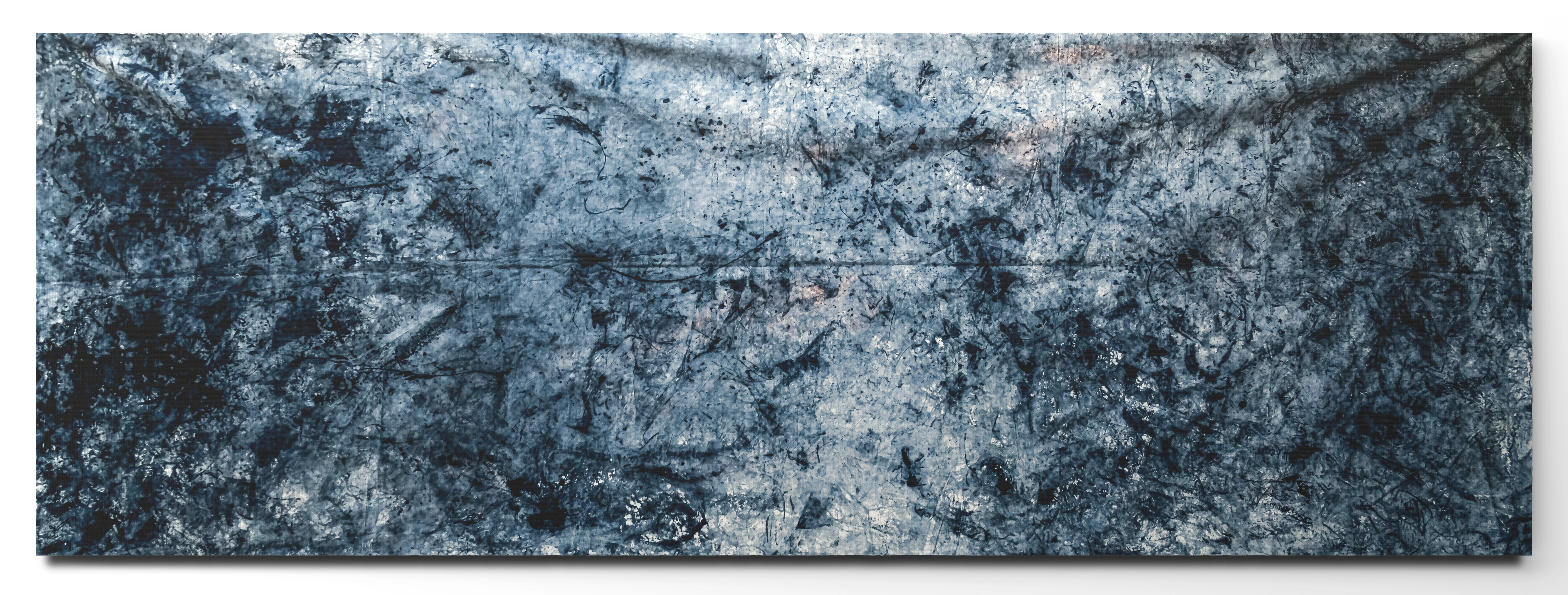
The strongest way to read Road No. 2 is as a painting of deliberate exposure. It feels as though the image has been brought to the point where anything more would weaken it. That is rare. Many paintings that seek spareness end up decorative or under-resolved; this one avoids both. Its field is pale, but it is not empty. Its marks are fine and numerous, but they are not casual. The painting earns its severity by keeping every one of its many small events below the threshold of climax, so that each carries weight without ever taking command.
Formally, the work is built from a bleached ground and a dispersed network of interruptions. Fine scratches, drawn arcs, scattered flecks, faint lateral lines, and denser blue-black concentrations pass across the surface without ever locking it shut. The eye is kept in a state of alert circulation. There is a central zone of darkened pressure, but even that does not function as a stable focal point. It feels more like a knot of accumulated hesitation than a climax. The image resists hierarchy.
This resistance is essential to the work's strength. Road No. 2 does not want to be read through a single dominant armature. It wants the viewer to experience the field as exposed enough that any trace might matter, but unstable enough that no trace can fully organize the whole. This gives the painting an unusual psychological charge. One looks as if reading a surface for evidence, not of narrative, but of pressure, contact, and prior movement.
The pale blue-grey tonality is doing far more than setting mood. It establishes a hard, dry visual climate in which the darker marks can register as incursions rather than embellishments. The painting's coolness is not serene. It is forensic. Light has been drained to a register where warmth would feel sentimental, and Bloom rightly refuses it. What remains is a field that looks weathered, scraped, and faintly exhausted, but still exact in its balance.
There is a notable intelligence in the scale of the marks. Some are so fine they barely hold the eye; others are heavier splashes or dragged compressions that begin to assert temporary local authority. Because the work stays so open, these scale differences become highly legible. The smallest line can alter the feeling of an entire quadrant. That is one of the reasons the painting feels so controlled: proportion here is doing the work that more dramatic contrast does elsewhere.
Historically, the work belongs to a harder line of abstraction that treats the exposed surface as a site of judgment rather than of lyric freedom. The painting is not trying to seduce through atmosphere, despite its cool tonal field. It is trying to test how much can be taken away before the image loses necessity. Bloom's answer is exacting: color can go, climax can go, hierarchy can go — provided the field keeps its density of fine incident and its balance stays exact.
This is where the painting's square shape becomes so important. A more panoramic proportion would have made the image read as road-memory or lateral drift. The square forces concentration. It creates a frontal, almost architectural stillness that the marks then trouble from within. The result is a productive contradiction: a static format holding a surface built from traces of motion. That contradiction gives the painting its peculiar tension.
As an object, Road No. 2 has real difficulty, which is part of its desirability. It does not flatter the room with heat or immediate drama. It sits there cool, exact, and almost withholding, and in doing so gains stature. This is a work that rewards prolonged looking because it refuses to spend itself at once. Its authority is quiet, but hard.
In the larger Ian Bloom record, Road No. 2 is essential because it proves that the road cycle was never only about force, darkness, or collision. It was also about exposure, reduction, and the intelligence of the nearly erased surface. If other works in the cycle deliver the road as wound, night, memory, or territorial spread, this one delivers it as a stripped field where only the most necessary traces remain. That is not a minor variation. It is one of the cycle's clearest acts of judgment.