Analysis
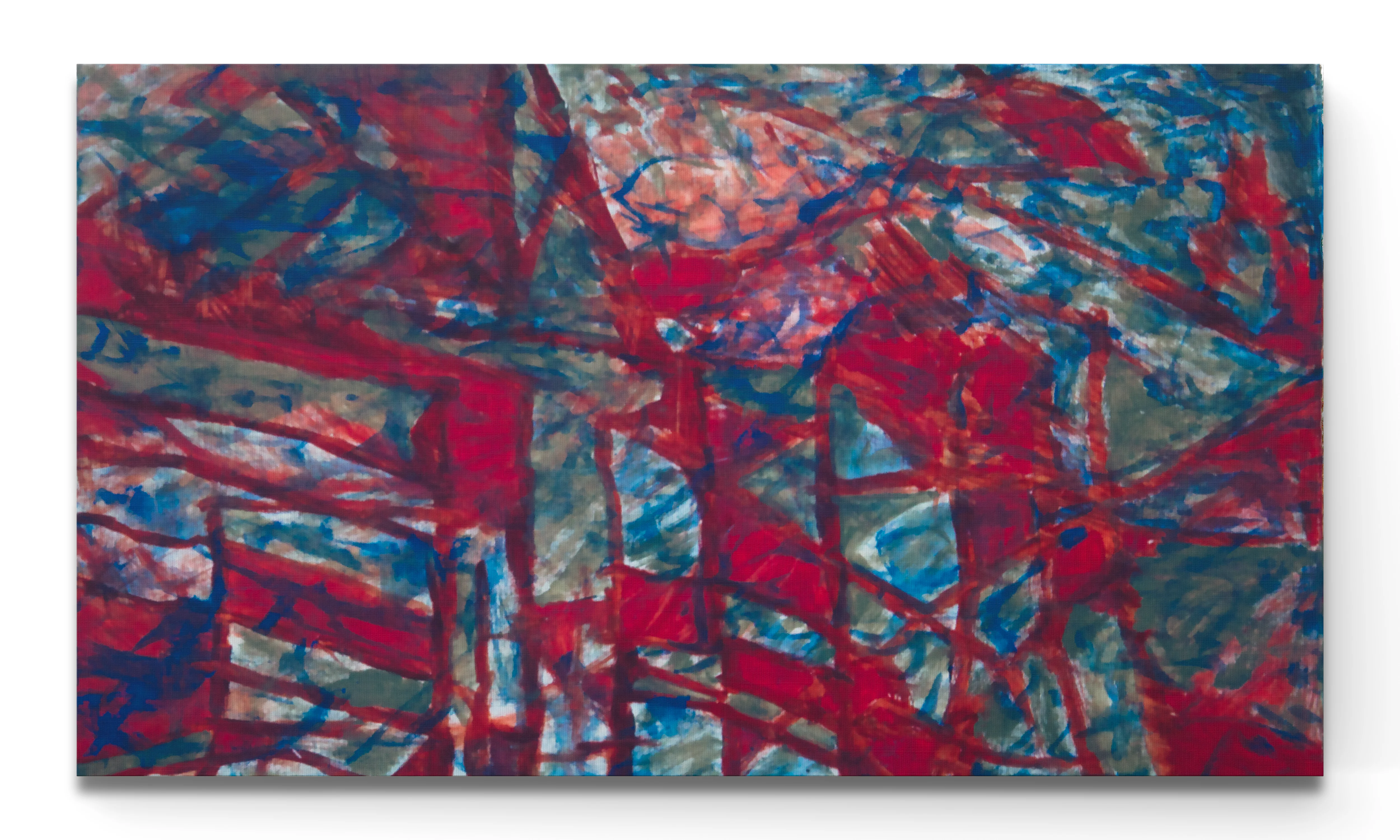
This is an early painting, and it looks like one — hot, congested, impatient, made by a twenty-one-year-old pushing harder than he could yet control. That is part of what makes it interesting. What it offers is an early demonstration of Bloom's instinct for containment through excess. The marks multiply, the color temperature rises, the black strokes slash and bind, but the field never gives way to mere expressionist spill. The painting remains held. That distinction matters historically. Many young painters can produce energy; fewer can make energy answer to pictorial necessity.
Formally, the work is built through opposition. Pink and red do not function here as decorative chroma or sentimental heat. They are pushed into service as carriers of agitation, saturation, and velocity. Black does the opposite work. It interrupts, anchors, cuts, and drags the eye laterally across the surface. The black marks are not outlines around color; they are governing agents inside it. They give the image its grammar. Without them, the painting would dissolve into fever. With them, it becomes conflict organized as form.
There is also a compelling ambiguity in the image's relation to depth. At first glance, the field appears flat, all surface and impact. But the longer one looks, the more small recessions and buried intervals begin to appear. Some marks seem to sit on top of the field, while others feel submerged beneath the red mass, like earlier decisions partially covered but not erased. This creates a sense of temporal layering. The painting reads not as one burst, but as a sequence of pressures accumulated and held in suspension.
Its strongest historical affinity is not with lyrical abstraction but with a harder lineage of postwar painting where gesture is only convincing when it earns structural consequence. The painting wants to be judged by its tensions, not by its excitement. And judged that way, it holds. The eye keeps moving because the image keeps withholding final resolution. One finds local incidents, a hooked dark form, a magenta loop, a red plane broken by a slash, but no single zone allows itself to become the whole story. The work sustains itself as a total field.
That totality is what gives the painting its object-status. It does not read like a fragment of a larger idea. It reads like a complete event. The horizontal shape intensifies this, because the image spreads like a strip of force or a band of accumulated sensation. It has something of the mural instinct without the theatrical emptiness that often comes with scale. Even reproduced, the work carries a physical insistence. One imagines it not hanging politely, but radiating outward into the room.
The title Untitled is appropriate, and stronger than a literary title would be. A name would risk shrinking the work to anecdote or psychological caption. Untitled leaves the burden where it belongs: on the painting's own ability to generate necessity. And this one does. It does not need a story to justify itself. Its authority comes from the fact that every formal decision appears to have been driven by the need to keep the field alive under pressure.
In the larger Ian Bloom record, this work reads as an early and genuinely developmental statement — rawer and less governed than the paintings that followed, and valuable for exactly that reason. Before the consolidated actor-producer image, before the later dealer logic, before the cold public architecture of the films and books, there is already this: force, appetite, and a visible struggle to keep volatility from remaining formless. Untitled is promising rather than final, and the promise is legible in every collision on its surface. The colder, more exact paintings of 2016 and 2022 are what that promise became.